
“Not a Locust Swarm! The Truth Behind the Large Summer Insects in Morocco”
"Not a Locust Swarm! The Truth Behind the Large Summer Insects in Morocco"

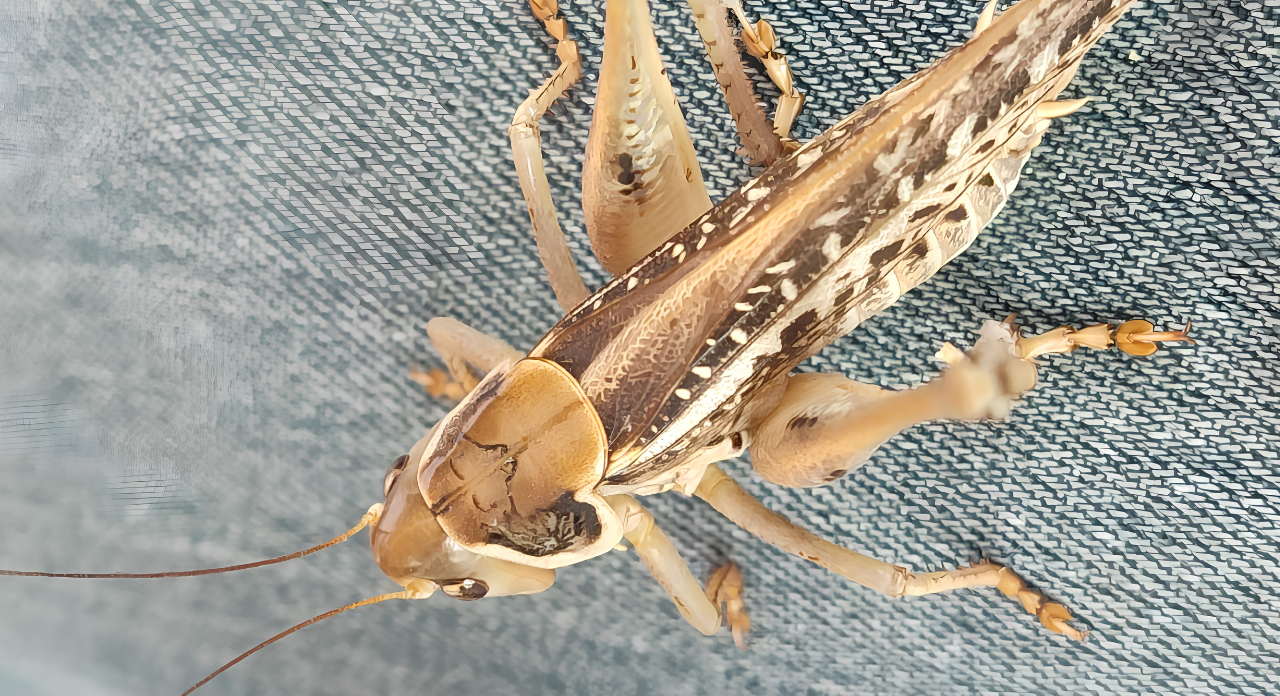
this insect currently attracting public attention in Morocco is not a migratory locust in the agricultural threat sense. Instead, it is a species of long-horn bush-cricket (or katydid) scientifically known as Decticus albifrons (White-fronted bush-cricket), belonging to the family Tettigoniidae.
Due to its large size and similar appearance, it is frequently confused with the Desert Locust or Migratory Locust. Below is a detailed report on its identity, the reasons behind its seasonal appearance, and its ecological impact.
True Identity: The White-fronted Bush-Cricket (Decticus albifrons)
The insect displays distinct morphological characteristics that clearly separate it from true locusts:
- Long Antennae: Looking closely at the head in the photo, the antennae are hair-like and exceptionally long, often exceeding the total body length. In contrast, true migratory locusts always feature very short antennae.
- Pronotum (Dorsal Shield): It exhibits dark patches framed by a lighter border on the sides of the head and thorax, which is a classic color pattern for this species.
- Hind Legs: Powerful and highly adapted for high and long-distance jumping when danger is sensed.
Why is it appearing in Morocco at this time?
The emergence of these bush-crickets in Morocco during late spring and early summer is a natural, seasonal phenomenon linked to the following factors:
- Life Cycle: Eggs hatch in the soil as the weather warms. The insect undergoes several molts to reach adulthood (as seen in the photo with fully developed wings) by early summer.
- Sudden Temperature Spikes: Heatwaves stimulate these insects to move and actively seek moisture and mating grounds, making them highly visible in agricultural zones and urban peripheries.
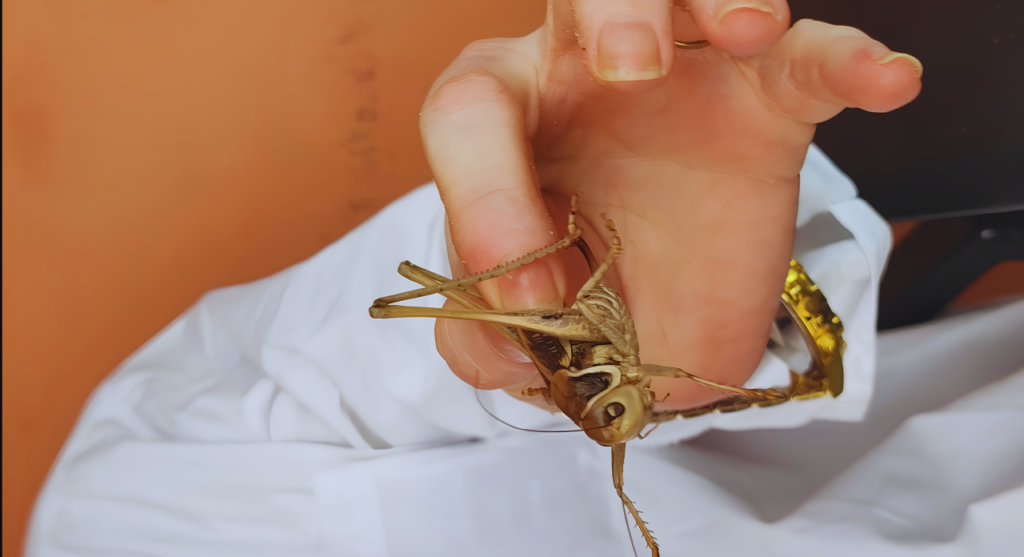
Dietary Habits: Is it destructive like locusts?
Unlike migratory locusts that form devastating swarms devouring all green vegetation, the White-fronted bush-cricket has a completely different diet:
Ecological Note: This insect is classified as omnivorous. While it feeds on leaves and grass, it is also an active predator that hunts larvae, caterpillars, butterflies, and other small insects, thereby contributing to ecological balance and natural pest control.
Does it pose a threat to humans or agriculture?
- For Humans: It is entirely non-toxic and non-venomous, carrying no diseases. However, due to its size and powerful jaws, it can deliver a minor defensive bite if handled improperly, which causes only a temporary sting.
- For Agriculture: It does not present a catastrophic threat. It may cause minor, localized damage in gardens or specific crops if numbers peak, but it never forms the massive, destructive swarms typical of Desert Locusts.