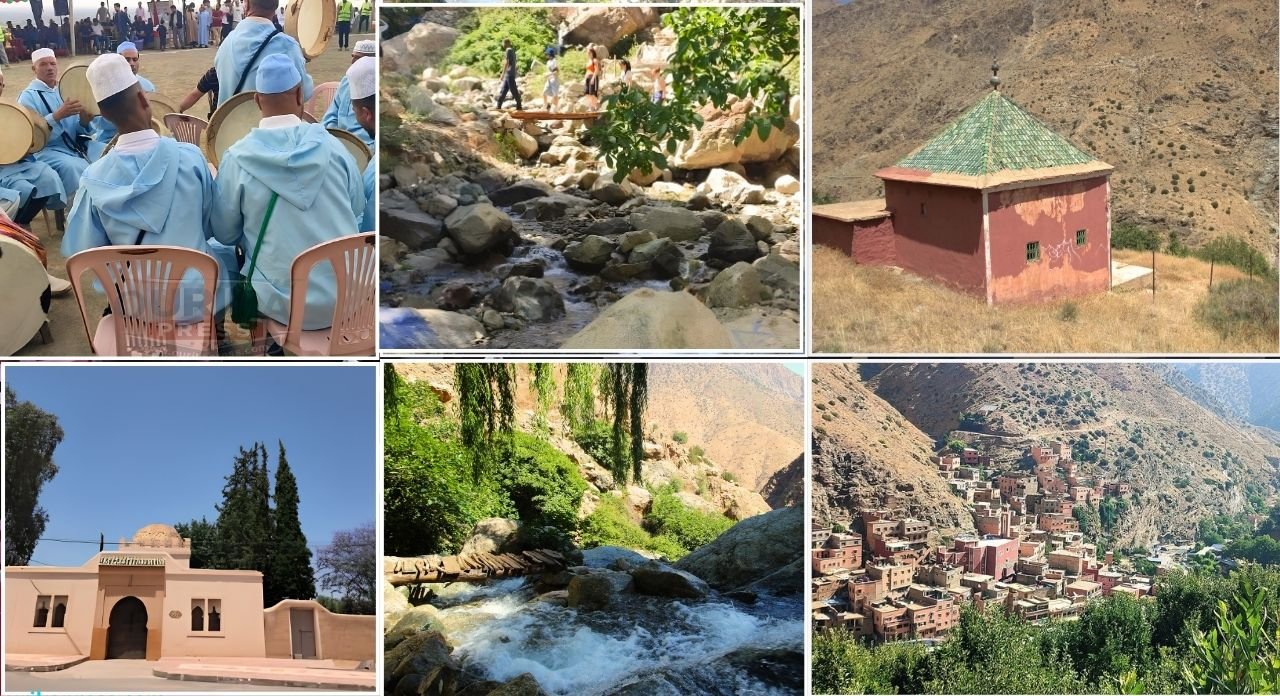
Ourika is not merely a name given to a valley or a tourist destination where visitors seek refuge from the hustle and bustle of the city; rather, it is a tale spanning centuries of history, spirituality, and collective memory. From the Setti Fatma waterfalls, which forged the region’s fame, to Aghmat, which cradles the mausoleum of the poet-king Al-Mu’tamid ibn Abbad, these lands harbor an exceptional cultural and human heritage that has made the name “Ourika” deeply resonant with significance and meaning.
Grounded in this rich heritage, the website’s administration has decided to prepare an in-depth research file in the form of a documentary volume. This work highlights the various facets of the Ourika region, relying on modern academic studies and reliable historical sources, with the aim of providing a comprehensive reference that introduces the reader to one of Morocco’s most prominent historical and natural domains.
This file will take the reader on an exploratory journey starting with the geographical location and topography of the region, moving through the origin of the name “Ourika” and its linguistic and historical connotations, then pausing at the biography of the righteous saint Lalla Setti Fatma and her spiritual sanctuary. It will then delve into the social and religious status of the mausoleum, introduce the tribes and villages (douars) that formed the region’s human fabric, and monitor the historical and contemporary transformations that Ourika has undergone, ultimately looking forward to its future balanced between heritage preservation and openness to the horizons of development and modernization.
It is an invitation to read Ourika through the eyes of history, geography, and humanity, and to discover the secrets of a region that was never just a tourist destination, but rather a space vibrant with identity.
In this tourism report, we take you on a journey to discover the origin of the region’s name, as well as the shrine of Lalla Setti Fatma, where it is located, and the visiting hours.